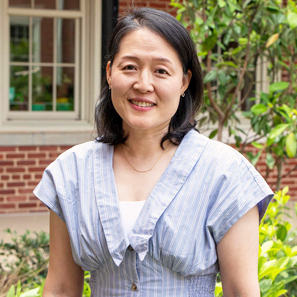
Oh-Ryeong Ha

Oh-Ryeong Ha

Associate Professor

Education

  • PhD, University of Louisville

Research Areas

  • Infant and child cognitive and social development
  • Health decisions and self-control
  • Media-based healthy eating interventions
  • Prosocial decision-making
  • Stress and emotional eating in young adults

Dr. Ha received a Ph.D. in Experimental Psychology with a concentration in Developmental Science from the University of Louisville in 2013, and completed a postdoctoral fellowship in the Department of Pediatrics at the University of Kansas Medical Center in 2016.

Dr. Ha’s research focuses on the mechanisms of cognitive and social development in the family context, including children’s eating decisions and self-control, media-based interventions for healthy eating, early risk factors for unhealthy food preference, prosocial decision-making and empathy in parent-child dyads, language acquisition in children with and without Williams Syndrome, and stress effects on prosocial decision-making and emotional eating in young adults. Dr. Ha uses behavior and experimental approaches such as eye-tracking, mouse-tracking, economic games, and stress/emotion manipulations.

ORCID

Google Scholar Profile

Will Pan

Will Pan

Assistant Professor

Education

  • Ph.D. in Clinical Psychology, Minor in Research, Measurement, and Statistics. University of North Texas

Research Areas

  • Development and validation of forensically relevant instrument and forensic assessment instrument
  • Feigning and under-reporting in forensic and clinical evaluations
  • Cultural factors and their influences on forensic evaluations
  • Violence risk assessment

Minqi “Will” Pan received his doctoral training in clinical psychology (forensic track) with a minor in Research, Measurement, and Statistics at University of North Texas. He completed both his pre-doctoral internship and post-doctoral fellowship at Patton State Hospital in California. He currently serves as the subcommittee chair of awards within the American Psychology-Law Society (APA Division 41) Teaching, Training, and Careers Committe.

Peter Castagna

Peter Castagna

Assistant Professor

Education

  • PhD, Clinical Psychology, Louisiana State University
  • Postdoctoral Research Fellow, Yale Child Study Center

Research Areas

  • Self-referential Processing
  • Computational Modeling
  • Neuroimaging (EEG, fMRI, DTI)
  • Child and Adolescent Psychopathology (anxiety, depression, conduct problems/callous-unemotional traits)
  • Executive Functioning
  • Emotion Regulation

Peter J. Castagna, Ph.D. is an Assistant Professor of Psychology (Child Clinical Concentration) at the University of Alabama. Dr. Castagna is a clinical scientist and cognitive/affective neuroscientist whose research focuses on how children and adolescents learn about themselves and others, and how these processes go awry in psychopathy-related traits. His program of research integrates self-referential processing, socioemotional learning, and executive functioning to understand mechanisms that confer risk for callous-unemotional traits, conduct problems, as well as internalizing difficulties (e.g., anxiety, depression). Methodologically, he combines behavioral tasks, parent- and self-report measures, and neuroimaging (EEG, fMRI) with computational approaches (e.g., drift diffusion and reinforcement-learning models) to decompose behavior into latent cognitive and affective processes and map them onto brain function. A core emphasis of his work is on parent–child dynamics and parenting behaviors as contexts that shape children’s self-concept, emotion regulation, and sensitivity to threat and reward. Ultimately, his goal is to leverage mechanistic insights (e.g., self-concept, acute and potential threat, reward learning, and cognitive control) to inform developmentally precise, neuroscience-informed interventions for youth.

Dr. Castagna earned his PhD in Clinical Psychology from Louisiana State University, completed his clinical internship at the Pennsylvania State University College of Medicine and his postdoctoral research fellowship at the Yale Child Study Center. He has over 50 peer-reviewed publications (30 first author) in a wide range of journals, such as Research on Child and Adolescent Psychopathology (formerly Journal of Abnormal Child Psychology), Journal of Clinical Child & Adolescent Psychopathology, Personality and Individual Differences, Journal of Affective Disorders, and NeuroImage.

  1. Castagna, P. J., Waters, A., & Crowley, M. J. (2022). Computational modeling of self-referential processing reveals domain general associations with adolescent anxiety symptoms. Research on Child and Adolescent Psychopathology (formerly Journal of Abnormal Child Psychology). https://doi.org/10.1007/s10802-022-01012-1
  2. Castagna, P. J., Waters, A. C., Edgar E. V., Budagzad-Jacobson, R., & Crowley, M. J. (2023) Catch the drift: Depressive symptoms track neural response during more efficient decision-making for negative self-referents. Journal of Affective Disorders Reports. https://doi.org/10.1016/j.jadr.2023.100593
  3. Castagna, P. J., Farahdel, E., Potenza, M. N., & Crowley, M. J. (2023). The current state-of-the-art in pharmacotherapy for pediatric generalized anxiety disorder. Expert Opinion on Pharmacotherapy, 24(7). https://doi.org/10.1080/14656566.2023.2199921
  4. Castagna, P. J., van Noordt, S. J. R., Sederberg, P. B., & Crowley, M. J. (2023). Modeling brain dynamics and eye-gaze behavior: bias and drift rate relate to frontal midline theta oscillations. https://doi.org/10.1016/j.neuroimage.2023.119871
  5. Castagna, P. J. & Waschbusch, D. A. (2022). Multi-informant ratings of childhood limited prosocial emotions: Mother, father, and teacher perspectives. Journal of Clinical Child and Adolescent Psychology, 52(1). https://doi.org/10.1080/15374416.2022.2151452
  6. Castagna, P. J., Babinski, D. E., Waxmonsky, J. G., & Waschbusch, D. (2022). The significance of limited prosocial emotions among externalizing disorders in children European Child & Adolescent Psychiatry, 31(4), 589-600. https://doi.org/10.1007/s00787-020-01696-0
  7. Castagna, P. J., & Crowley, M. J. (2021). Relationship between puberty and inhibitory control: Computational modeling of the drift-diffusion process. Developmental Neuropsychology, 46(5), 360-380. https://doi.org/10.1080/87565641.2021.1952206
  8. Castagna, P. J. (2019). Structure related to function: Prefrontal surface area has an indirect effect on the relationship between amygdala volume and trait neuroticism. Brain Structure and Function, 224 (9), 3309-3320. https://doi.org/10.1007/s00429-019-01974-x
Despina Stavrinos

Despina Stavrinos

Professor
Director of ISSR

Education

Despina Stavrinos, PhD is Professor of Psychology and Founder and Director of the UAB Translational Research for Injury Prevention (TRIP) Laboratory (www.triplaboratory.com). Dr. Stavrinos’ program of research focuses broadly on the context of unintentional injury prevention and control with a strong focus on transportation-related issues from a cognitive and developmental perspective.

Over the past decade, Dr. Stavrinos has served as PI on grants from NIH, CDC, DOT, US Army, and industry totaling over $9 million. Currently, Dr. Stavrinos is PI on 2 longitudinal studies funded by NIH. REACT is examining driving attention among newly licensed adolescents. Findings will shape policy regarding the optimal age and experience for licensure. R2DRV is evaluating the effects of mild traumatic brain injury on teen driving performance to inform clinical practice guidelines on when teens can safely return to drive. Under Dr. Stavrinos’ leadership, the TRIP Lab acquired the first SUV driving simulator in the world through partnerships with Honda Manufacturing of Alabama and the Alabama Department of Transportation. The simulator has been featured on the TODAY show and CNN.

Dr. Stavrinos graduated from The University of Alabama with a BS in Psychology (Minor in Biology), earned both her MA and PhD (Developmental Psychology) from the University of Alabama at Birmingham, and was a Postdoctoral Fellow at the UAB University Transportation Center. She has received numerous awards, including the Routh Early Career Award in Pediatric Psychology, Dean’s Award for Excellence in Mentorship, and Birmingham Business Journal’s Top 40 Under 40 in 2020.

Dr. Stavrinos serves on the Editorial Board for Accident Analysis and Prevention, Journal of Pediatric Psychology, Human Behavior and Emerging Technology, and Journal of Clinical Psychology. She is the elected Chair of the Alabama Head and Spinal Cord Injury Trust Fund Advisory Board and serves on the Transportation Research Board of the National Academies of Science Standing Committee on Road User Measurement and Evaluation and the Standing Committee on Vehicle User Education, Training, and Licensing. Dr. Stavrinos serves as a consultant for academic research and legal/expert witness testimony.

Sharla Biefeld

Sharla Biefeld

Assistant Professor

Education

Research Areas

Dr. Biefeld is an Assistant Professor with the Center for Youth Development and Intervention and leads the BODY Lab. Dr. Biefeld’s research centers on how the bodies we live in shape our experiences, how others treat us, and how we develop.

Dr. Biefeld completed a PhD and Master of Science in Developmental Psychology at the University of Kentucky and a Bachelor of Arts in Psychology and Women and Gender Studies at the University of Texas at Austin. Prior to her work in developmental psychology, she worked in eating disorder treatment and in reproductive health research.

Centers

Kelsey West

Kelsey West

Assistant Professor

Education

Research Areas

Dr. Kelsey West is an Assistant Professor at the University of Alabama. She received her PhD from the University of Pittsburgh and conducted a postdoctoral fellowship at New York University.

In the Bama Baby Lab, we study infant learning across the first three years of life. Even before they begin pre-school, infants master a remarkable array of foundational skills. They learn hundreds of words, acquire motor skills like crawling and walking, produce a variety of gestures, and play with objects in sophisticated ways. Is infants’ simultaneous learning across domains purely coincidence, or are the domains related? Using laboratory experiments and natural observations of infants at home, our research documents how: (1) Infants actively construct their own learning environments; (2) New skills in one domain—like learning to point, walk, or say “yes” and “no”—can ripple across other domains of infant learning; (3) Delays or atypicality in one domain can have far-reaching effects on infants’ other emerging skills. We study variability in development process in neurotypical infants, autistic infants, and infants with language delay.

Dr. West is a faculty member in the Center for Innovative Research in Autism

  1. West, K.L., Fletcher, K.F., Adolph, K.E., & Tamis-LeMonda, C.S. (2022). Mothers talk about infant actions: How verbs correspond to infants’ real-time behavior. Developmental Psychology. 58(3), 405–416
  2. West, K.L., & Iverson, J.M. (2021). Communication changes when infants begin to walk. Developmental Science, e13102.
  3. West, K.L. (2019). Infant motor development in autism spectrum disorder: A synthesis and meta-analysis. Child Development, 90, 2053-2070.
  4. West, K.L., Leezenbaum, N.B., Northrup, J.B., & Iverson, J.M. (2019). The relation between walking and language in infant siblings of children with autism spectrum disorder. Child Development, 90, e356-e372.
  5. West, K.L., Iverson, J.M. (2017). Language learning is hands-on: Exploring links between infants’ object manipulation and verbal input. Cognitive Development, 43, 190-200.
Summer Braun

Summer Braun

Assistant Professor

Education

Research Areas

Summer Braun joined the faculty from the University of Virginia, where she was a Postdoctoral Research Associate in the School of Education and Human Development. She earned her Ph.D. in Human Development and Family Studies at The Pennsylvania State University.

Dr. Braun’s research is motivated by ecological systems models, which emphasize the importance of understanding development in context. Her research centers on schools as a particularly salient context for children’s development. Her program of research focuses on understanding the associations between teachers’ occupational health and well-being and their students’ social, emotional, and behavioral development using a variety of methodological approaches. Her work bridges research and practice by studying interventions designed to support the well-being of teachers and students, such as mindfulness-based wellness programs.

Katie Garrison

Katie Garrison

Associate Professor

Research Areas

Katie Garrison is an associate professor in the Department of Psychology. She received her PhD in social and personality psychology from Texas A&M University in 2020. Katie is interested in experimental psychology in general, and particularly the interplay of emotion, cognition, and motivation in self-control.

Courses Taught
PY 101: Introduction to Psychology
PY 672: Advanced Social Psychology
PY 656: Seminar in Social Psychology, Self-Control
PY 607: Research Methods
Susan White

Susan White

Doddridge Saxon Chairholder
Professor
Director, Center for Youth Development and Intervention

Education

Research Areas

Susan W. White is Professor and Doddridge Saxon Chair in Clinical Psychology at the University of Alabama. Her clinical and research interests include the development and evaluation of psychosocial treatments that target transdiagnostic processes underlying psychopathology. She is associate editor for the Journal of Clinical Child and Adolescent Psychology and the Journal of Autism and Developmental Disorders, and she the Editor in Chief of the ABCT Series on Implementation of Clinical Approaches. Her research has been funded by the National Institutes of Health and the Department of Defense. She received her PhD from Florida State University

Jenny M. Cundiff

Associate Professor

Education

Research Areas

Jenny M. Cundiff received her doctorate in clinical psychology with an emphasis in health psychology from the University of Utah in 2014, subsequently completing two years of postdoctoral training in cardiovascular behavioral medicine at the University of Pittsburgh. Her research examines if and how our social lives contribute to poor health. Much of her work has been focused specifically on biopsychosocial mechanisms (e.g., stress physiology, social interactions) linking lower social status to poor health. Her work has been funded by the American Psychological Association and Division 38 (Health Psychology).

Lab Website

Health, Relationships, and Disparities (HeRD) Lab